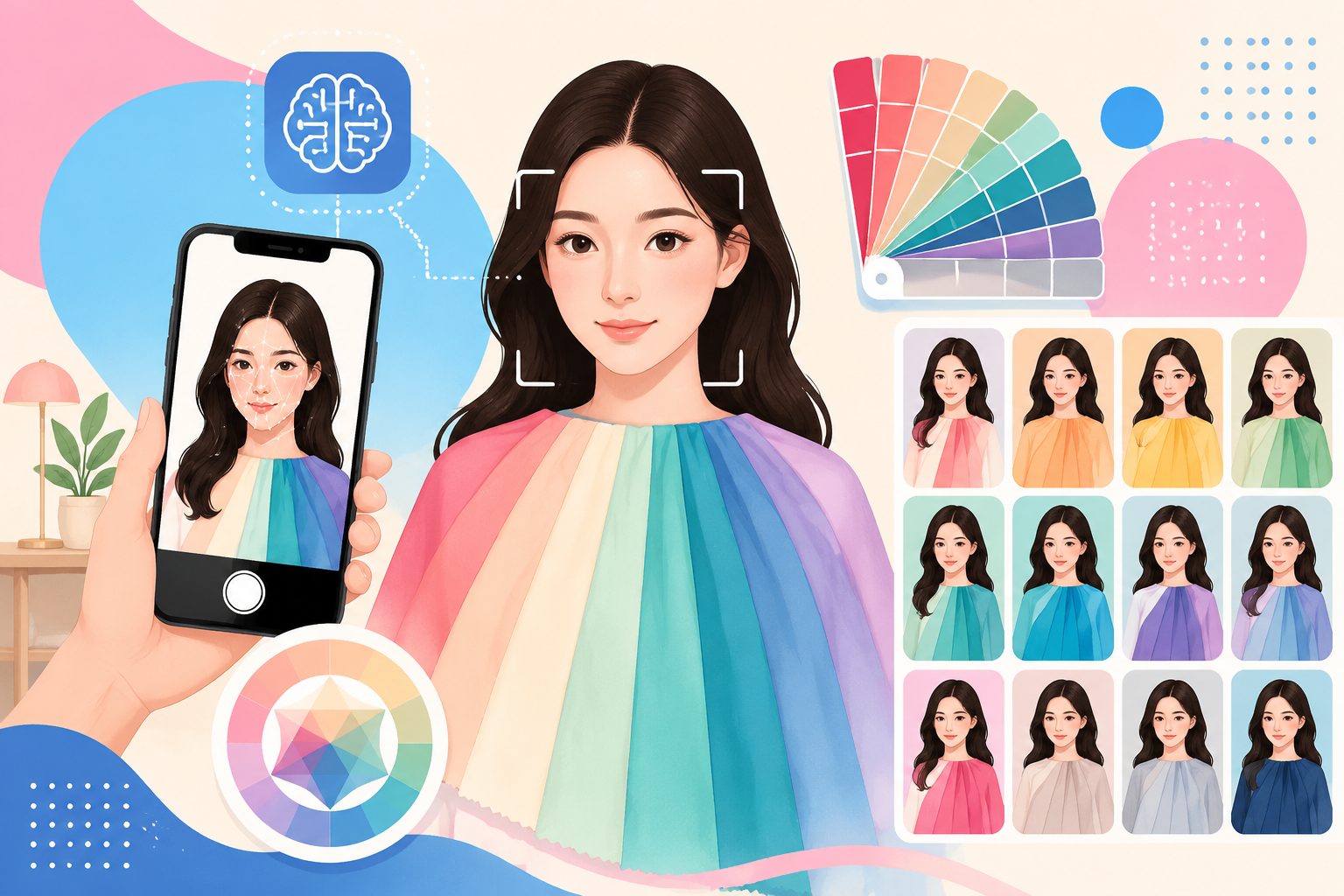
AI Personal Color Analysis Prompts 2026: 12 Copy-Ready Templates

Professional colour analysis is a real service with real value — and a real waiting list and price tag, wherever you live. The modern boom started in South Korea, where studio-based personal colour diagnosis became a mainstream beauty ritual, and it has since spread through TikTok and Instagram to salons in New York, London, Sydney and everywhere in between. What most people actually want, though, is a first pass: a credible read on whether they are warm or cool, and which five colours to buy first.
That first pass is exactly what a well-written prompt delivers. Asking a model “what’s my colour season?” gets you a shrug in paragraph form. Specifying the axes it must evaluate — undertone, value, chroma — and the exact output format gets you something close to a usable diagnostic sheet. Below are twelve templates in four groups: core diagnosis, makeup, wardrobe, and shareable content.
The prompt text is deliberately written in English inside every code block. Image models handle colour vocabulary — undertone, chroma, value, muted, bright — far more precisely in English, so we keep the instruction in English and let you swap the closing “Answer in English” line for any language you prefer.
What do you need before you start?
One front-facing selfie in natural daylight, with no makeup and no filter. This single input caps the accuracy of all twelve prompts below — the model reads light bouncing off your skin, so a warm indoor bulb or a beauty filter means it diagnoses the filter, not you.
Three rules: stand near a window during daylight with overhead lights and flash off, pull all hair back so your neck and jawline show, and wear white or grey so no garment colour reflects onto your face. Bare lips matter more than bare eyes — lip colour is one of the four signals the diagnosis leans on.
Then open ChatIMG.ai — five free images a day, no login required. Use GPT-Image-2 for written diagnostic reports and Nano Banana 2 for makeup and hair visualisations.
How do you get an accurate four-season result?
Force the model to evaluate four separate signals before it concludes. The four-season system (Spring, Summer, Autumn, Winter) rests on one main axis — warm versus cool — but a model that jumps straight to a season guesses. A model that reports undertone, eye colour, hair depth and lip colour first, then synthesises, is auditable: you can see which signal drove the call.
Prompt 1: Four-season baseline diagnosis
Analyze the person in this photo and determine which of the four seasonal
color types fits best: Spring (warm-light), Summer (cool-light),
Autumn (warm-deep), Winter (cool-deep).

Evaluate these four signals separately before concluding:
1. Skin undertone (yellow / neutral / pink)
2. Natural eye color and its clarity
3. Natural hair color and depth
4. Natural lip color

Then give: the final season, the three defining traits of that season,
and five recommended makeup colors with hex codes.
Explain your reasoning for each of the four signals.
Answer in English.
Prompt 2: Twelve-type precision diagnosis
Classify this person into exactly one of the twelve personal color types:
Light Spring, True Spring, Bright Spring, Light Summer, True Summer,
Soft Summer, Soft Autumn, True Autumn, Dark Autumn, Bright Winter,
True Winter, Deep Winter.

Judge on three axes and state a score for each:
- Value (light vs deep)
- Chroma (bright vs muted)
- Temperature (warm vs cool)

Output: the single winning type, a five-color signature palette with hex
codes, three colors to avoid, and one sentence on how this type differs
from its two nearest neighbours.
Answer in English.
Prompt 3: Sixteen-type plus personality styling
Combine the sixteen-type personal color system (4 seasons x 4 tones) with
the user's MBTI to produce a styling profile.

Input: [selfie attached] + [my MBTI: e.g. INFJ]

Deliver:
1. The exact 16-type diagnosis name
2. Three fashion styles that suit this type + MBTI combination
3. Five well-known people with similar colouring
4. One short caption I can post with my result card

Keep the tone friendly and concrete, no vague adjectives.
Answer in English.
How do you make makeup prompts specific enough to shop from?
Name the brands you can actually buy, and demand shade numbers. “Warm-toned lipstick” is not a shopping list. Constraining the model to a retail range you have access to — and asking for brand plus shade code plus reasoning — turns the output into something you can take to a counter or a checkout page.
Prompt 4: Lipstick shade matching
Diagnose this person's personal color type from the selfie, then recommend
five specific lipstick shades from brands sold widely at mainstream
retailers (for example: MAC, NARS, Charlotte Tilbury, Rare Beauty,
Maybelline, Fenty Beauty, Clinique).

For each pick give: brand + exact shade number or name + finish
(matte / satin / gloss) + why it works for this color type + whether it
suits daytime or evening wear.
Also name two shade families to avoid and explain why.
Answer in English.
Prompt 5: Everyday makeup visualisation
First diagnose this person's personal color type, then generate an image
showing a natural everyday makeup look matched to that type. Include:

- Base tone (light beige / golden / rosy / neutral)
- Eyeshadow: a three-colour gradient
- Blush: placement and colour
- Lip colour: one shade
- Suggested hair colour shift (subtle)

Keep the original face, bone structure and expression unchanged.
Only makeup and hair colour should change.
Answer in English and describe what you changed.
Prompt 6: Hair colour simulation
Simulate the three hair colours that best suit this person's personal
color type. For each simulation specify:

1. The dye tone (ash brown, dark chocolate, caramel, black-brown,
   olive brown, warm chestnut — pick from these)
2. Whether highlights or lowlights are included
3. How value and temperature both shift versus the natural colour

Output the three results side by side for comparison.
Keep the face, expression and camera angle identical across all three.
Answer in English.
Can wardrobe prompts produce something you’d actually wear tomorrow?
Yes, if you state the occasion, the dress code and the retail tier. A palette with no context stays theoretical. Telling the model “office-appropriate, purchasable from mass-market high street brands” is what turns a colour wheel into three outfits you can assemble this week.
Prompt 7: Workwear colour pairings
Based on this person's personal color diagnosis, build three office outfit
sets suitable for a 25-35 year old professional.

Each set: top + bottom + outerwear + bag colour.

Constraints:
- Restrained colours that work across seasons
- Appropriate for a business-casual dress code
- Colours obtainable from mass-market brands (UNIQLO, ZARA, COS, H&M,
  Everlane, Massimo Dutti)
Give hex codes for every colour named.
Answer in English.
Prompt 8: Occasion dressing
Using this person's personal color result, recommend colours for four
occasions:

1. First date, bright daytime cafe
2. Formal dinner, evening, low warm light
3. Wedding guest, daytime outdoor ceremony
4. One statement piece: a gown or formal dress for a black-tie event

For each: hex codes, garment type, fabric finish (matte / satin / sheer),
and accessory metal tone (gold vs silver vs rose gold).
Answer in English.
Prompt 9: Celebrity colour twins
Name five well-known public figures whose natural colouring is closest to
this person's diagnosed type.

For each: one signature look of theirs, and three concrete, copyable
details (a lip shade family, a hair length and colour, a coat colour).

Then flag two widely copied trends that would NOT suit this type,
and say what to substitute instead.
Answer in English.
How do you turn the result into a shareable card?
Write the dimensions, the layout and the exact on-image copy into the prompt. Almost every failed result card traces back to two omissions: no aspect ratio, and unquoted text. Models render quoted strings far more reliably than paraphrased instructions like “add the result at the top”.
Prompt 10: Social result card
Generate a 1080x1350 vertical share card presenting this person's personal
color result. Layout:

- Top: the diagnosis name, e.g. "True Winter"
- Middle: the selfie plus a five-swatch palette with hex codes printed
- Bottom: one line of makeup advice + five hashtags

Minimal editorial design, generous white space, print-sharp legible type,
no watermark, no gibberish characters.
Answer in English.
Prompt 11: Group photo batch diagnosis
From this group photo of four people, diagnose each person separately.

Format the output as:

[Person 1, left to right] — four-season type + twelve-type
[Person 2] — four-season type + twelve-type
[Person 3] — four-season type + twelve-type
[Person 4] — four-season type + twelve-type

For each person: three signature colours with hex codes.
Finally, suggest one outfit-colour combination for the whole group that
flatters all four types in the same photo.
Answer in English.
Prompt 12: Trend colour filtering
From the 2026 spring/summer trend colours currently circulating
(Mocha Mousse, Butter Yellow, Cherry Red, Sage Green, Lavender, Aura Indigo),
pick the three that best suit this person's personal color type.

For each: the hex or Pantone code, why it matches the diagnosed type
(reference value / chroma / temperature), and one concrete way to wear it
(garment, makeup, nail or hair — pick one).

End with a single-line answer to: "the one item worth buying this season".
Answer in English.
Which of the twelve should you actually run?
Pick by the decision you’re trying to make, not by running all twelve. Most people need exactly one: Prompt 1 if you’ve never been analysed, Prompt 4 if you just want to stop buying the wrong lipstick.
| Your goal | Use | Suggested model |
|---|---|---|
| First-ever analysis, warm vs cool | Prompt 1 | GPT-Image-2 |
| Refine a known season to twelve-type | Prompt 2 | GPT-Image-2 |
| Preview a makeup look | Prompt 5 | Nano Banana 2 |
| Preview a hair colour before the salon | Prompt 6 | Nano Banana 2 |
| Shopping decisions | Prompts 4, 7, 8 | GPT-Image-2 |
| Content for social | Prompt 10 | GPT-Image-2 |
| Doing it with friends | Prompt 11 | GPT-Image-2 |
FAQ
How close is an AI result to a professional in-person analysis?
Close on direction, looser on precision. The four-season call — essentially warm versus cool — is where agreement is strongest. Twelve-type precision, which a trained analyst establishes by draping dozens of fabric swatches under controlled light, is where a photo-based read starts to slip. One Korea-based comparison we’ve seen put agreement around three-quarters at the season level and roughly six in ten at the twelve-type level; that was a Korean studio sample and shouldn’t be read as a measurement of your local market, but the shape of the finding — broad strokes reliable, fine grain less so — matches what we see elsewhere.
Can I get a result without uploading a photo?
You can ask, but treat it as entertainment. Undertone assessment is fundamentally visual, and a text description like “I have olive-ish skin” carries too little signal. Accuracy climbs sharply the moment there’s an actual image to read.
Why are the prompts in English?
Because colour vocabulary is more precisely represented in English. Terms like undertone, chroma and value have dense, consistent usage in English sources and much thinner coverage elsewhere. Keeping the instruction in English and changing only the final “Answer in English” line gives you the best of both.
What if the result contradicts what I already believed?
Check the lighting first. Most disagreements come from the photo: warm indoor bulbs push cool skin toward a warm read, and backlighting flattens value so light types get called deep. Reshoot in daylight and run it again — if two clean photos agree, the result is probably telling you something.
How should I spend the free daily quota?
Spend it on one diagnosis plus one visualisation rather than re-rolling the same prompt. ChatIMG.ai gives five free images a day without an account; registering unlocks more quota, saved history and batch runs. See pricing for details.
Do these work for men?
Yes. Seasonal analysis is not gender-specific, and Prompts 1, 2, 6 and 7 apply unchanged. For Prompt 4, swap “lipstick shades” for “shirt, tie and knitwear colours” and the rest of the structure holds.
Next step
Copy any prompt above, open ChatIMG.ai, attach your selfie, and read the result in about thirty seconds.
Related reading:
- AI personal color test: the complete guide
- How to shoot a selfie that gives an accurate colour reading
- The four-season colour system explained
- Gold or silver? A quick undertone check
— ChatIMG.ai Team
More in this series
- ChatGPT Prompt vs Paid App vs chatimg.ai: 3 Color-Analysis Paths Compared | ChatIMG
- How to Take a Color Analysis Selfie (Right) — r/coloranalysis 258K Community Consensus + AI Validation
- Gold or Silver? Reddit's #1 Monthly Question (and why binary picking is wrong) — 6-Metal Gradient Self-Test
- What Lipstick Shade Suits My Skin Tone? 4 Seasons × 5 Occasions = 25 Real SKUs | ChatIMG
- What Hairstyle Suits My Face? AI Previews 30 Seconds Before You Commit
View all 13 articles in Personal Colour Analysis →