Nano Banana 2.1 · 海报、广告与排版
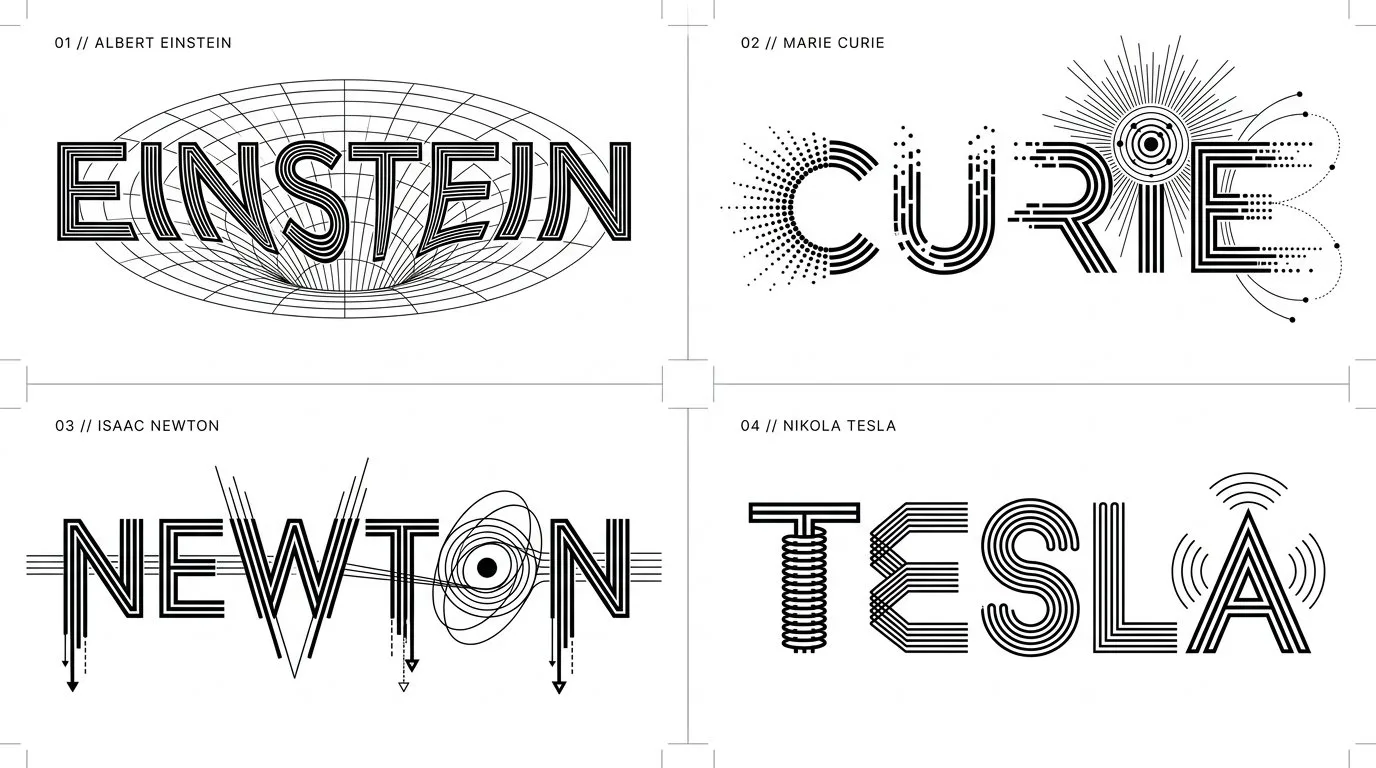
四位科学家的实验字标
作者 Gadgetify (@Gdgtify) · · 看原帖 ↗
提示词
2x2 grid, 16:9, do this for 4 famous scientists: CONCEPT ANCHOR 1:
"Experimental geometric wordmark — custom-built uppercase
letterforms, monoline geometry, alternating thick and thin
strokes, deliberately interrupted character segments,
mechanically precise shapes, optical alignment,
architectural negative space."

::

CONCEPT ANCHOR 2:
"Semantic symbol typography — recognizable visual symbols
integrated directly into the anatomy of letters, including
modified counters, transformed stems, symbolic crossbars,
illustrative terminals, and conceptual ligatures."

::

CONCEPT ANCHOR 3:
"Vintage scientific and engineering lettering — parallel
technical lines, concentric rings, rotational diagrams,
rhythmic stroke repetition, exploded mechanical shapes,
technical-drawing precision, scientific schematic clarity."

::

CONCEPT ANCHOR 4:
"Swiss modernist minimalist identity — immaculate white
background, pure black graphic elements, striking negative
space, precisely controlled typography, asymmetrical visual
balance, intellectually playful reduction."

INSTRUCTION:

Find the precise visual intersection of these four concepts.

Ignore the literal technological terminology
and subject matter in the references.

Extract only their visual design DNA.

Create an extraordinary experimental typographic
wordmark for $ SUBJECT.

The letters must become an intelligent visual
expression of the subject's defining meaning.

This is not ordinary text decorated with icons.

The word itself must transform into a symbolic
piece of visual engineering.

SUBJECT ANALYSIS:

First determine:

1. The most recognizable word or short phrase
   representing $ SUBJECT.

2. Its strongest defining visual characteristic.

3. Its dominant conceptual properties.

4. Three to five relevant visual symbols.

5. The geometric behaviors that best communicate
   the subject.

6. Which letters offer the most promising
   opportunities for transformation.

SEMANTIC TRANSFORMATION:

If the subject represents:

MOTION:
Use directional strokes, displacement, repeated
contours, kinetic breaks, and rhythmic geometry.

NATURE:
Translate growth, branching, organic repetition,
and environmental forms into letter anatomy.

SCIENCE:
Use scientific geometry, orbital paths, schematic
forms, diagrams, and precision linework.

MUSIC:
Incorporate visual rhythm, wave structures,
oscillations, and musical relationships.

ARCHITECTURE:
Transform stems and counters into arches,
structural supports, beams, and architectural voids.

TECHNOLOGY:
Use mechanical precision, circuitry, modular
systems, communication patterns, or interface geometry.

EMOTION:
Use spatial tension, expansion, compression,
contrast, distortion, or expressive continuity.

HISTORY:
Use carefully selected era-specific geometric
or typographic influences.

ABSTRACT CONCEPTS:
Invent a meaningful visual metaphor and
translate it into letter construction.

OTHER SUBJECTS:
Infer a unique transformation appropriate
to the subject's actual meaning.

LETTERFORM CONSTRUCTION:

Start with a custom geometric uppercase wordmark.

Transform selected characters through:

- parallel stroke multiplication
- interrupted or fragmented stems
- negative-space symbols
- custom ligatures
- extended horizontal bars
- geometric letter substitutions
- contour-line repetition
- directional stroke bending
- optical illusion effects
- embedded subject-specific pictograms
- carefully controlled line thickness
- mathematical relationships between shapes

Preserve character recognition.

At least two characters should exhibit
meaningful custom transformations.

Every transformation must serve the
concept rather than exist as decoration.

COMPOSITION:

Present ONE unified wordmark centered within
a generous white canvas.

Use a horizontal composition for longer names.

Use a compact stacked lockup when the text
naturally benefits from multiple lines.

Allow selected characters to extend beyond
the standard letter height when necessary.

Maintain carefully balanced optical spacing.

Let negative space contribute as much
as the black geometry.

VISUAL STYLE:

- pure black lettering
- clean white background
- high-contrast vector-like precision
- crisp geometric contours
- controlled thin parallel lines
- variable stroke density
- subject-driven symbolic elements
- elegant modular structure
- visually clever typographic surprises

STRICT RULES:

No unnecessary illustrations.
No photographic objects.
No gradients.
No 3D extrusion.
No decorative backgrounds.
No mockups.
No unrelated symbols.
No default electrical motifs.

Do not sacrifice readability for cleverness.

OUTPUT:

A visually ingenious minimalist typographic
identity for $ SUBJECT where the wordmark itself
becomes a symbolic machine, diagram, sculpture,
or optical expression of the subject.

Elegant from far away.
Surprisingly intelligent up close.
Immediately recognizable.
Distinctly original.
创作者公开的原文提示词 · https://x.com/Gdgtify/status/2113000873714442552
怎么用这条提示词
- 点「用这条提示词出图」,ChatImg 会选好 Nano Banana 2.1 并填好提示词——不会自动生成,确认后再点生成。
- 把主体、风格或文字换成你自己的想法。
- 生成后继续对话微调细节。
更多 Nano Banana 2.1 提示词
全部 Nano Banana 2.1 提示词 →


作品与提示词归原作者所有,本页署名并链接原帖展示。需要下架请在 GitHub 提 issue。 github.com/mofa-si/awesome-nano-banana-2-1-prompts